
Here is a question most DeFi users never think to ask: why can you do less on a decentralized exchan 2026-7-23 12:42:46 Author: hackernoon.com(查看原文) 阅读量:3 收藏
Here is a question most DeFi users never think to ask: why can you do less on a decentralized exchange than on the centralized one you supposedly graduated from?
A Binance account gives a first-week trader limit orders, algorithmic execution and stop losses. A vanilla automated market maker gives a self-custodying veteran exactly one tool, the market swap, and wishes them luck with the slippage. That gap has been DeFi's quiet embarrassment for years. It is now closing, integration by integration, and the market update from Ring Protocol today is a useful window into how.
Ring Protocol, a multi-chain decentralized exchange, said that it has integrated dLIMIT and dTWAP, the decentralized limit order and time-weighted average price protocols built by Orbs, bringing both order types to its traders on Base, Arbitrum, Ethereum and BNB Chain at no additional cost. The features run on Orbs' Layer 3 infrastructure, and users keep custody of their assets throughout.
The Exchange Is Moving On-Chain
Zoom out before judging any single integration, because the ground under this one has moved. For most of DeFi's existence, decentralized exchanges hovered at 8 to 14 percent of centralized spot volume, a hobbyist's share. Then it broke. CoinGecko's tracking shows the DEX-to-CEX spot ratio hitting 18.7 percent in January 2025, spiking to an all-time high of 37.4 percent in June 2025 when Binance began routing Alpha platform orders through PancakeSwap, and then settling around 20 percent for five consecutive months into November, which is the more meaningful fact. Spikes are events. A held level is a habit. Decentralized exchanges processed $4.9 trillion in spot volume across 2025, and PancakeSwap and Uniswap now sit inside the top ten spot venues on Earth, ahead of Coinbase, OKX and Upbit by cumulative volume over the August 2025 to January 2026 stretch.
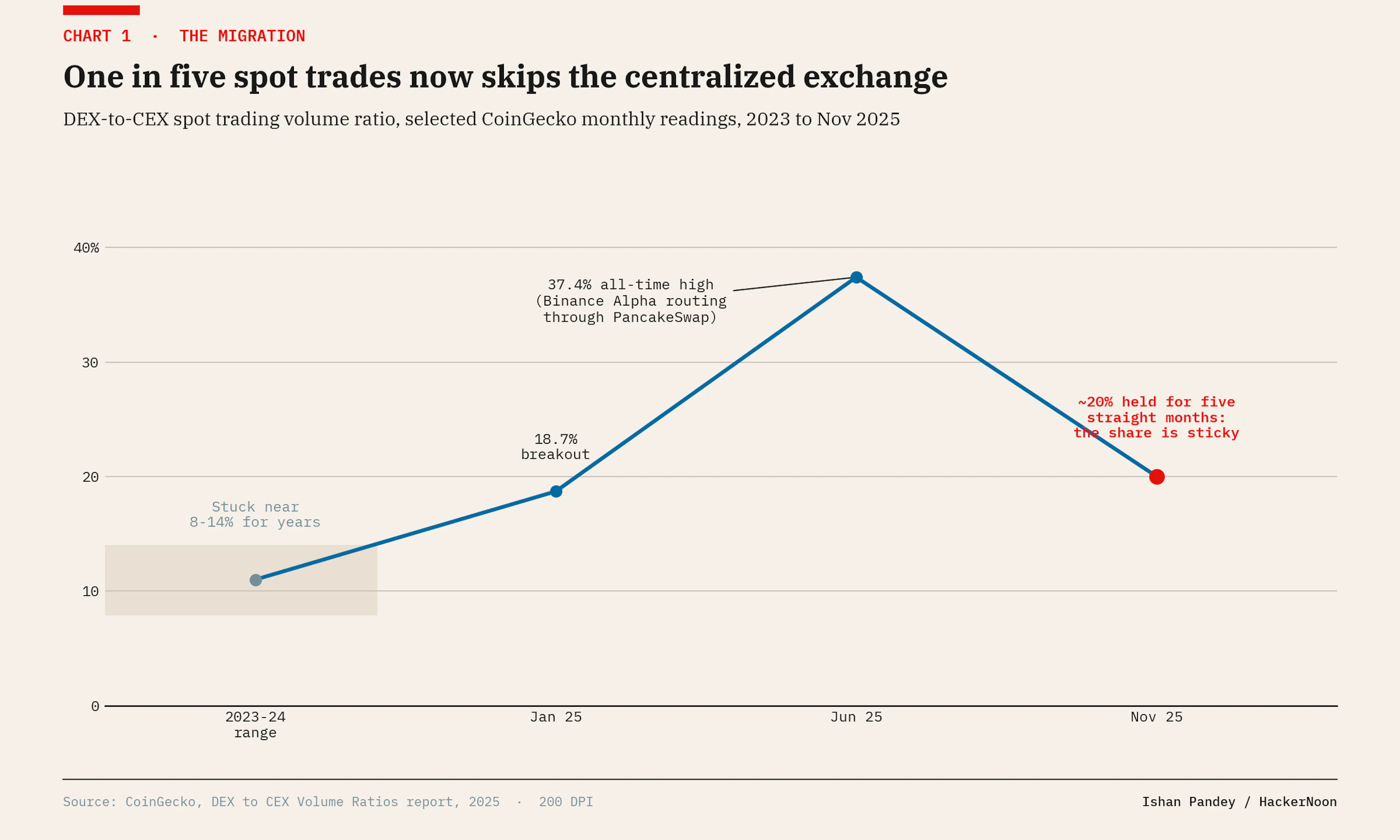 DEX-to-CEX spot volume ratio, selected readings.
There is a self-custody undercurrent pushing the same direction. Centralized venues lost over $2 billion to hacks in roughly a year, most of it in the February 2025 Bybit exploit, and every incident converts another cohort of traders to the on-chain habit. But those converts arrive with centralized-exchange expectations, and this is exactly where the story stops being about volume and starts being about capability.
The Gap This Integration Closes
Break down what a trader actually gives up when moving from a centralized order book to a vanilla AMM, and the trade looks worse than most people admit. The order book venue offers market orders, limit orders, TWAPs and stop losses; the AMM offers a swap button. The AMM's counteroffer, self-custody, is real and increasingly decisive, but it should not have to cost a trader every execution tool invented since the telegraph. Smart contracts on their own cannot conveniently do the waiting and watching that a limit order requires; something has to monitor prices continuously and fire the trade at the right moment, and doing that fully on-chain is precisely the hard part.
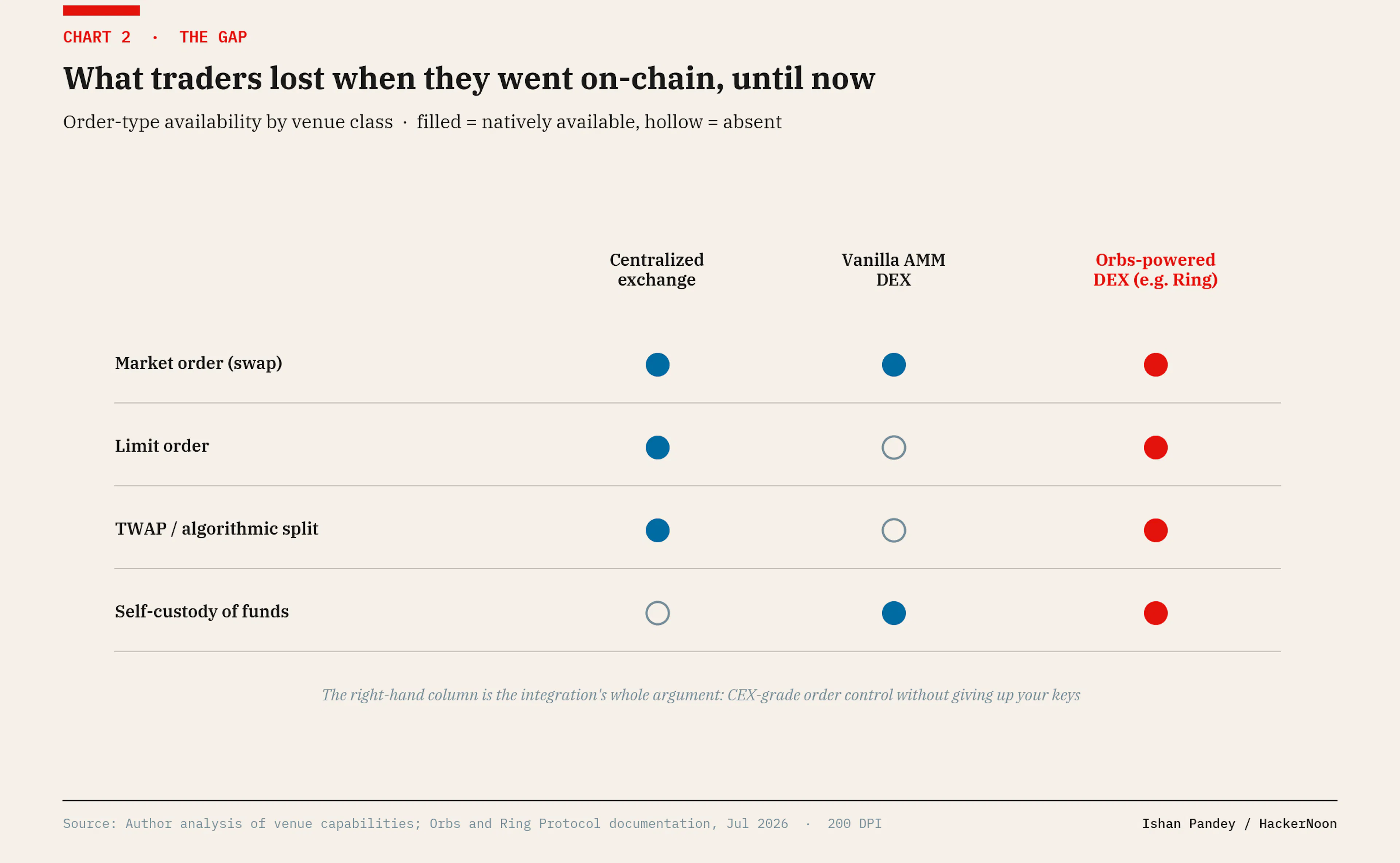 Order-type availability by venue class. The right column is the integration's argument.
Orbs' answer is architectural. Its Layer 3 network sits as a supplementary execution layer above existing chains, using a Proof-of-Stake validator set to run the always-on logic that native smart contracts cannot, then settling results back to the DEX's own contracts. The design detail that matters for adoption: DEXs bolt this on without changing their underlying infrastructure or migrating liquidity anywhere. That is why the integration list keeps growing instead of stalling on switching costs.
What Traders on Ring Actually Get, in Plain Terms
Two tools, both simpler than their acronyms. A dLIMIT order is a price condition with patience. The trader names a price, and the order executes only when the market reaches it or better. No babysitting charts, no centralized matching engine holding the order, no intermediary holding the funds. For anyone who has watched a target price print at 4 a.m. while asleep, this is the entire pitch.
A dTWAP order is camouflage for size. It takes one large trade and slices it into smaller pieces executed over a period the trader configures. The reason to bother is mechanical: on-chain liquidity pools reprice with every trade, so a single large order literally pushes the price away from itself as it fills, and the seller eats that slippage. Twelve small fills spread across an afternoon stay close to the market's average price and leave a far smaller footprint. It is the same logic institutional desks have used in equities for decades, which is why TWAP execution is often described as the first genuinely institutional habit to reach retail DeFi.
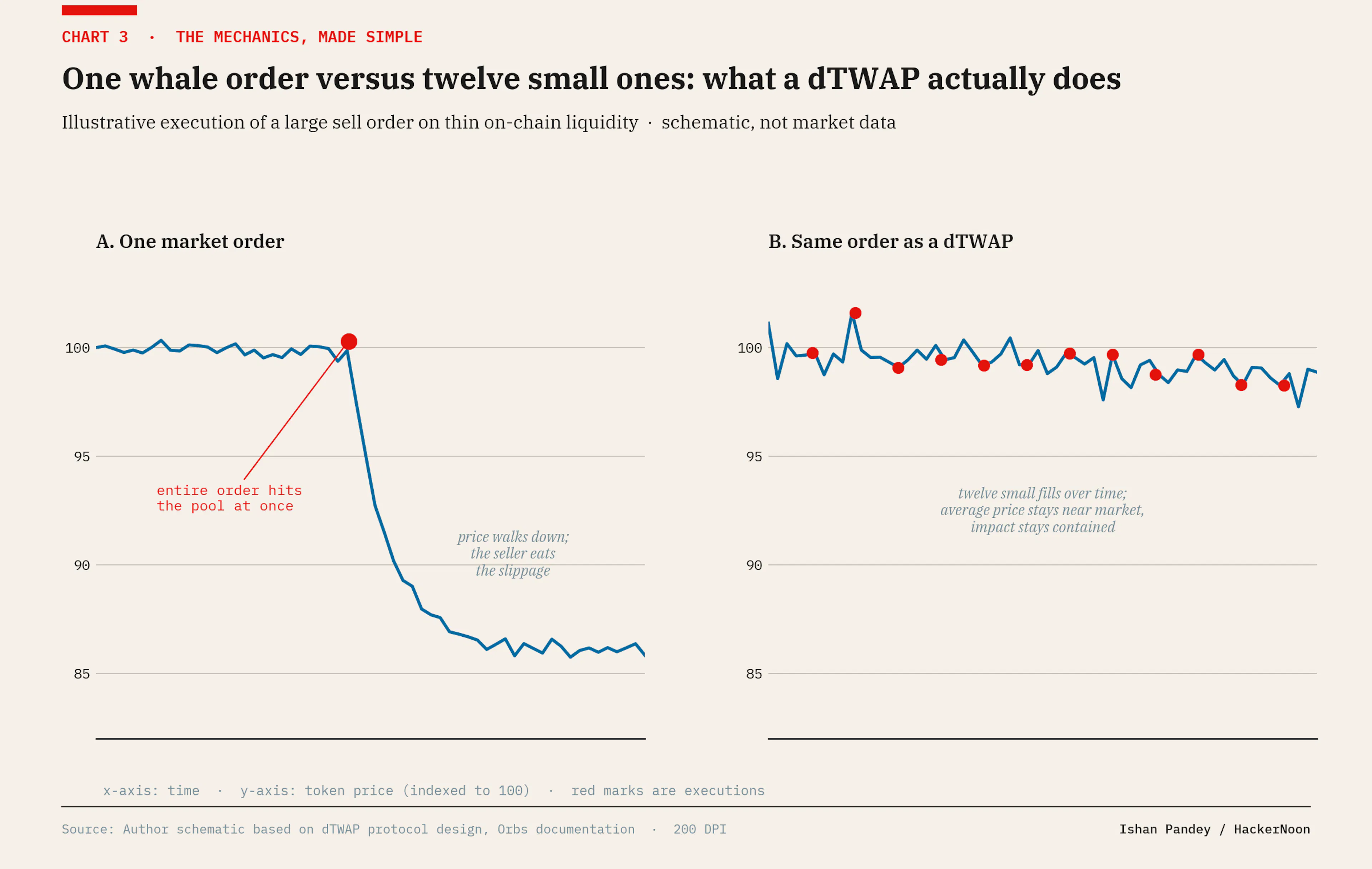 One whale order versus twelve small ones: the slippage case for TWAP execution, schematically.
For Ring specifically, the tools land on unusual plumbing. The exchange is built around Few Protocol, short for Financial Elastic Wrapping, an asset layer that wraps tokens before they touch the automated market maker, which the project says unlocks virtual liquidity and trading behavior beyond a conventional AMM's reach. Per project documentation, Ring has processed more than $5 billion in cumulative volume and holds over $30 million in total value locked across an eight-chain deployment that spans Ethereum, Base, Arbitrum, BNB Chain, X Layer, MegaETH, HyperEVM and Unichain. Those are mid-tier numbers by design, and that is what makes the integration interesting as a signal: advanced execution is no longer a flagship-DEX luxury. It is becoming table stakes for venues a tenth of PancakeSwap's size.
The Bigger Story: Execution Is Quietly Consolidating
Here is the insight worth taking away even if you never touch Ring. While attention went to liquidity wars and incentive programs, on-chain execution consolidated around a shared layer most users have never heard of. Orbs-powered order protocols now run on 38 decentralized exchanges across 26 blockchain networks, including PancakeSwap, SushiSwap, QuickSwap, THENA and SpookySwap. The company reports $2.5 billion in spot volume through its execution protocols since 2023, and over $14.1 billion across its full product line once perpetuals and liquidity routing are counted.
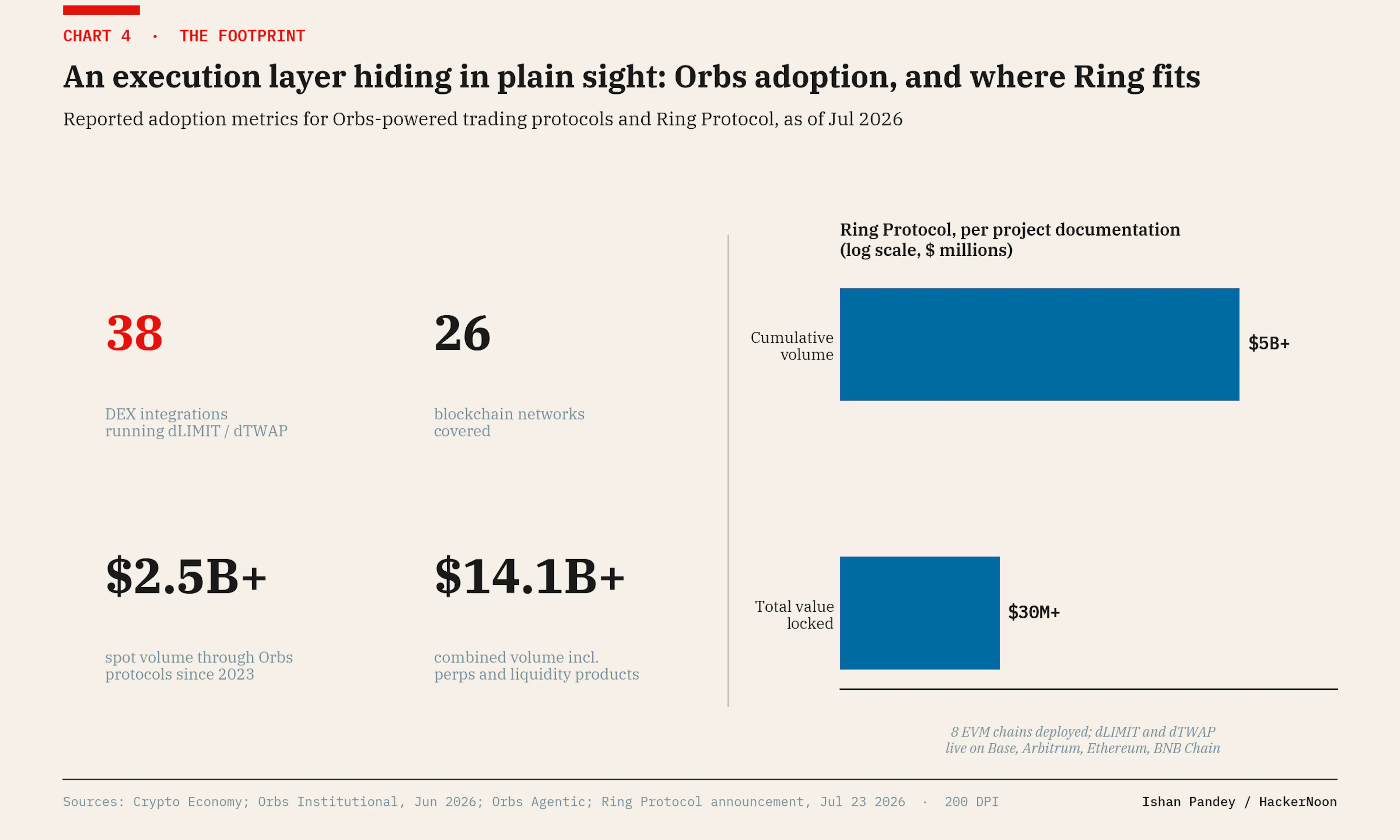 The Orbs execution footprint, and Ring's own reported numbers.
The strategic read is straightforward. When dozens of exchanges outsource the same capability to the same backend, that backend starts to look like infrastructure rather than a feature, closer to what clearing and execution networks became in traditional markets than to a DeFi widget. For DEXs, it converts a multi-month engineering project into an integration. For traders, it means the interface they already use quietly gains professional tooling. And for the sector, it moves the competitive frontier: when execution quality is available to everyone through a shared layer, exchanges go back to competing on liquidity depth, chain coverage and product imagination, which is roughly where Ring's Few Protocol wrapper is trying to play.
Worth stating plainly what this integration is not. It is not a token event, not a fundraise, and it will not move a market on its own. It is a capability upgrade inside a structural migration, and those tend to matter in aggregate rather than individually, which is exactly why they deserve analysis rather than a shrug.
What to Watch
Three markers will show whether this integration compounds or just decorates. Watch Ring's advanced-order share. The honest metric for any dLIMIT and dTWAP deployment is what fraction of venue volume flows through the new order types after the novelty fades. Orbs infrastructure reports execution on-chain, so this is checkable: meaningful sustained share by year end would confirm traders actually wanted the tools, not just the announcement.
Watch whether the execution layer keeps consolidating. The integration count, 38 DEXs and climbing, is the number that turns Orbs from vendor into standard. The counter-scenario also deserves attention: Uniswap-style intent architectures and aggregator-native limit orders are converging on the same problem from different directions, and the next twelve months will show whether shared Layer 3 execution or in-house intent systems win the category.
Watch the whale behavior on Ring's smaller pools. TWAP execution matters most exactly where liquidity is thinnest, which describes mid-tier multi-chain venues like this one. If Ring's pools start absorbing larger trades without the price scarring visible in their history, that is the integration working as designed, visible to anyone with a block explorer.
Vested Interest Disclosure: HackerNoon has reviewed the report for quality, but the claims herein belong to the author. All market data is independently sourced and hyperlinked. Do your own research. #DYOR.
如有侵权请联系:admin#unsafe.sh