
Every company can call the same AI model. Almost none can make it work inside one messy customer. Th 2026-7-22 17:27:56 Author: hackernoon.com(查看原文) 阅读量:3 收藏
Every company can call the same AI model. Almost none can make it work inside one messy customer. That gap is the most valuable job in software right now.
Why This Role Exploded Now
For most of software history, the hard part was building the product. Distribution was hard, but the code was the moat. If you built something no one else could build, you won.
AI broke that assumption.
The frontier model you use is, more or less, the frontier model your competitor uses. The impressive demo runs on the same weights everyone else can rent by the token. The clever prompt is copyable. The wrapper is a weekend project. When the core capability is available to everyone, being able to build the thing stops being the moat.
What's left is the last mile: getting that capability to actually work inside one specific company, with their broken data, their compliance rules, their legacy system that only Dave understands, and their deep and reasonable suspicion that this will be another tool that overpromises.
That last mile is not a smaller version of the product. It is a different job. And it is the job AI can't do alone, because it's mostly not a coding problem.
Anyone can call the model. Almost no one can sit in the customer's mess and make it actually work. That gap is the job.
What a Forward Deployed Engineer Actually Does
Strip away the plane tickets and the role comes down to closing four gaps that sit between a capable product and a customer getting value. I'll call it the Field Loop — because it runs on repeat, in the field, not in a planning doc.
| Move | What it means | Why the AI can't just do it |
|---|---|---|
| Embed | Sit inside the customer's real environment and see how work actually happens | The messy truth is never written down anywhere a model can read |
| Translate | Turn a vague business pain into a precise, buildable spec | The customer can't articulate what they need; someone has to extract it |
| Ship | Build the integration, glue, and last-mile fix — in days, not quarters | Trust is earned by watching something work on your data, this week |
| Feed Back | Carry what broke in the field back into the core product | What fails on-site almost never reaches the roadmap on its own |
Notice what dominates that table: judgment, translation, and trust. Exactly the things that don't compress into a prompt.
An FDE is not a consultant who leaves a slide deck. They are not a sales engineer who runs the demo and hands off. They are an engineer with a product's full power behind them and permission to bend it to one customer's reality — then bring the lessons home so the product gets better for the next hundred customers.
Figure 1: The Field Loop
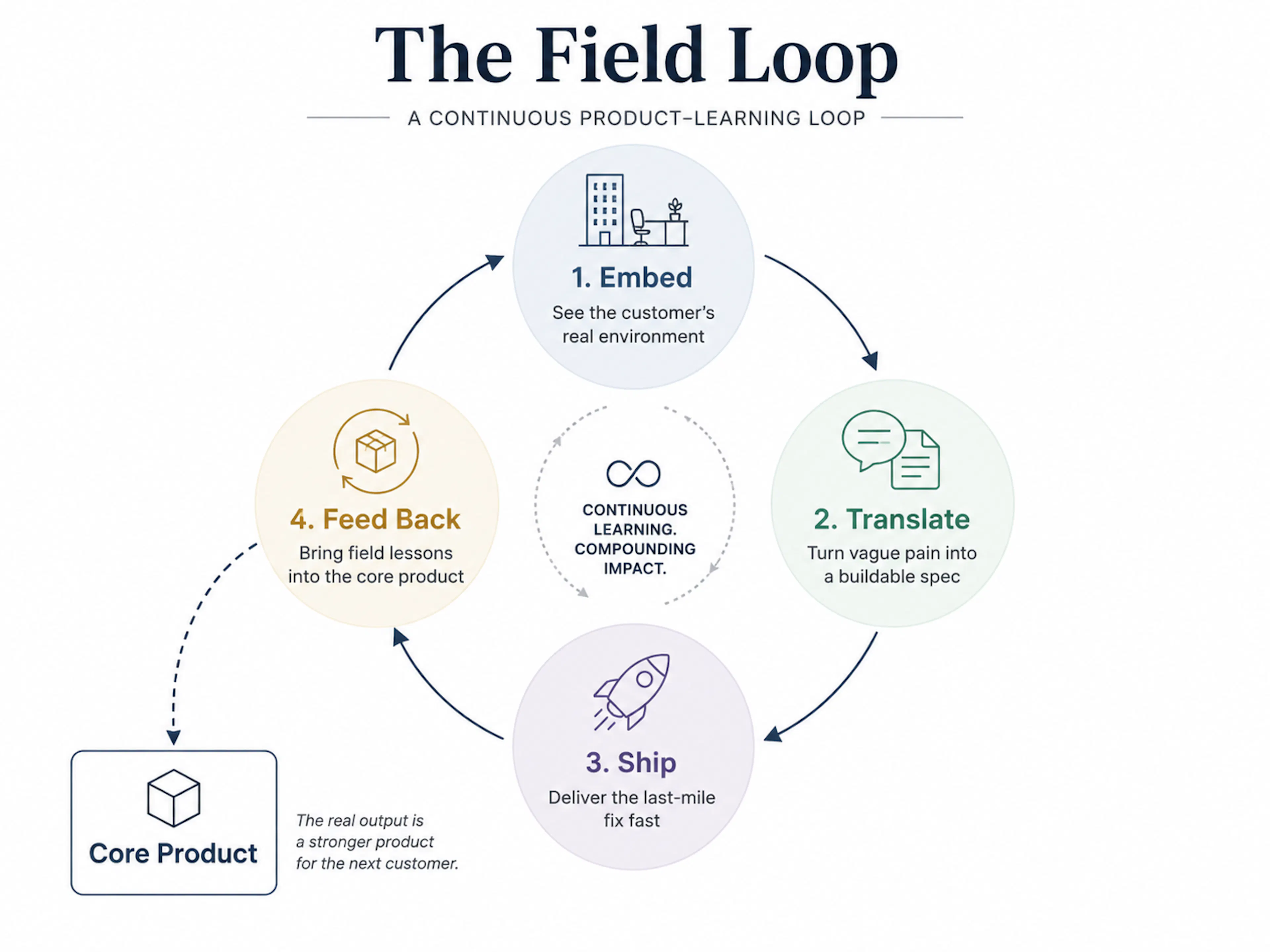 The LOOP
A simple circle: Embed → Translate → Ship → Feed Back, with the arrow from Feed Back curving back into the core product, not back to the same customer. The loop's output isn't one happy client — it's a product that needed less forward-deploying next time.
That feedback arrow is the whole strategy. A great FDE org works itself out of a job on each problem, because every field fix that matters gets absorbed into the product. Bad ones become a consulting shop that reinvents the same integration forever.
Who Should Care, and Why
This is the part that usually gets skipped, so let's be direct about it.
If you're an engineer: this is the opposite of a demotion. As raw code generation gets cheaper, the scarce skill is not typing faster — it's being the person who can walk into ambiguity, figure out what actually needs to exist, and make it real against a real deadline with a real human watching. That's leverage. FDEs at strong companies are often the highest-context, fastest-promoted people in the building, because they've seen where the product meets the world.
If you're a PM: the FDE is the realest user research you will ever get. Not a survey, not a call — an engineer who lived inside the workflow and came back with the three things that are actually blocking adoption. Ignore that channel and you'll ship features nobody asked for while the real blocker sits untouched.
If you're in leadership: forward deployed engineering is how you turn a commodity capability into a defensible business. The moat isn't the model. It's the accumulated, hard-won knowledge of how your product survives contact with fifty different messy realities — knowledge that only exists because someone was in the room. Competitors can copy your demo. They can't copy your field loop.
The Fear Nobody Says Out Loud
Here's the anxiety under all of this: if AI can write the code, and eventually integrate itself, doesn't the human in the loop just get automated away too?
Backwards. The more capable the models get, the more the bottleneck moves to the one thing they structurally can't do — be trusted in a room. Someone has to decide what "working" means for this customer. Someone has to be accountable when it touches their money, their data, their regulator. Someone has to earn the "okay, we'll roll it out" that no autonomous agent will ever be handed by a nervous VP.
Abundant intelligence doesn't erase the person who translates business reality into a working system. It makes that person the most valuable role in the company.
The scarcest thing in an AI company isn't compute. It's someone the customer will actually let into the building.
The Takeaway
Forward deployed engineering is not a support function or a fancy word for consulting. It's the recognition that when everyone has the same intelligence on tap, the winner is whoever closes the last mile fastest — and that the last mile is a human problem wearing an engineering costume.
The best AI companies of this decade won't be the ones with a slightly better model. They'll be the ones who figured out how to embed, translate, ship, and feed back faster than anyone else.
The model is a commodity. The engineer who walks into the customer's building is the moat.
如有侵权请联系:admin#unsafe.sh