Cisco Unified Communications Manager Server-Side Request Forgery VulnerabilityCisco Unifi 2026-6-24 22:0:0 Author: horizon3.ai(查看原文) 阅读量:8 收藏
Cisco Unified Communications Manager Server-Side Request Forgery Vulnerability
Cisco Unified Communications Manager (Unified CM) and Cisco Unified Communications Manager Session Management Edition (Unified CM SME) contain a critical server-side request forgery (SSRF) vulnerability that could allow an unauthenticated remote attacker to write files to the underlying operating system and ultimately escalate privileges to root. Tracked as CVE-2026-20230, the vulnerability stems from improper input validation of specific HTTP requests processed by the WebDialer service. Cisco assigned the vulnerability a CVSS score of 8.6 and rated it Critical due to the potential for root-level compromise. Public proof-of-concept exploit code is available, and exploitation has been observed in the wild.
What it is and why it matters
CVE-2026-20230 affects Cisco Unified CM and Unified CM SME deployments where the WebDialer service is enabled. An unauthenticated attacker can send crafted HTTP requests that exploit an SSRF condition, enabling file writes to the underlying operating system. Successful exploitation can then be leveraged to gain root-level access.
This vulnerability is particularly concerning because:
- No authentication is required.
- Public proof-of-concept code is available.
- Successful exploitation can result in full root-level compromise.
- Active exploitation has been reported.
- Unified CM platforms are commonly deployed in healthcare, government, financial services, telecommunications, and other large enterprise environments where communications infrastructure is mission critical.
Technical Details
The vulnerability exists because affected systems improperly validate specific HTTP requests handled by the WebDialer service. An attacker can abuse this weakness to force the application to make unintended requests and write files to the underlying operating system.
According to Cisco, exploitation requires the WebDialer service to be enabled. WebDialer is disabled by default, reducing exposure for organizations that do not use the feature.
Once arbitrary files can be written to the operating system, attackers can leverage the access to escalate privileges and obtain root-level control of the appliance.
Stop Guessing, Start Proving
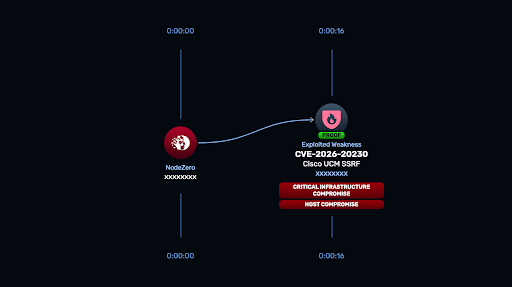
NodeZero® Proactive Security Platform — Rapid Response
A NodeZero Rapid Response test has been developed to safely validate whether this server-side request forgery vulnerability can be exploited in your environment. The test executes real attack techniques without causing damage, giving teams immediate clarity on exposure.
- Run the Rapid Response test: Launch from the NodeZero platform to determine whether the vulnerability is exploitable in your environment
- Patch immediately: Upgrade to Unified CM 14SU6 or later, or Unified CM 15SU5 or later. Apply Cisco’s interim COP patch for affected 15.x deployments where appropriate
- Re-run the test: Confirm the vulnerability is no longer exploitable after remediation
Affected versions & patch
Affected versions include:
- Cisco Unified Communications Manager Release 14 prior to 14SU6
- Cisco Unified Communications Manager Release 15 prior to 15SU5
- Cisco Unified Communications Manager Session Management Edition versions aligned with the affected release trains
Cisco recommends:
- Upgrading to Unified CM 14SU6 or later for Release 14 deployments
- Upgrading to Unified CM 15SU5 or later for Release 15 deployments
- Applying Cisco’s interim COP patch for affected 15.x systems until upgrades can be completed
- Disabling WebDialer if it is not required for business operations
Timeline
- June 3, 2026 – Cisco published security advisory cisco-sa-cucm-ssrf-cXPnHcW and disclosed CVE-2026-20230.
- June 5, 2026 – Public reporting highlighted the availability of proof-of-concept exploit code.
- June 22, 2026 – Security researchers reported observing exploitation attempts targeting vulnerable systems.
- June 23, 2026 – Multiple security outlets reported active exploitation of CVE-2026-20230 in the wild.
- June 24, 2026 – Horizon3.ai released a NodeZero Rapid Response test for CVE-2026-20230.
References
Read about other CVEs
NodeZero® Platform
Implement a continuous find, fix, and verify loop with NodeZero
The NodeZero® platform empowers your organization to reduce your security risks by autonomously finding exploitable weaknesses in your network, giving you detailed guidance around how to priortize and fix them, and having you immediately verify that your fixes are effective.
Recognized By
如有侵权请联系:admin#unsafe.sh