
Across many industries, organizations are unifying security and putting AI agents to work. Security 2026-6-18 19:36:8 Author: www.microsoft.com(查看原文) 阅读量:8 收藏
Across many industries, organizations are unifying security and putting AI agents to work. Security teams are utilizing agents that reason, decide, and act on their behalf, under their governance. At Microsoft, we see this firsthand—more than 80% of the Fortune 500 are already using AI.1 The promise of this moment is enormous. The responsibility that comes with it is just as significant. This year, Microsoft commissioned Forrester Consulting to conduct a Total Economic Impact™ (TEI) study for our AI-first, end-to-end security platform.
What end-to-end security delivers
Based on in-depth interviews with a survey of 362 customers and 11 security decision-makers using Microsoft Security solutions, the Forrester study revealed the impact of consolidating with Microsoft Security. To model the financial impact, Forrester aggregated insights into a single composite organization—a global business-to-business (B2B) company with 10,000 employees—and constructed a TEI framework that quantifies costs, benefits, and risks. Through its study, Forrester projected that an organization would experience the following over three years.
- Up to 30% reduction in the likelihood of a breach
Integrated protection across identities, endpoints, data, and infrastructure helps prevent attacks before they succeed.
- Up to 25% reduction in cost to remediate remaining attacks
End-to-end visibility and coordinated response cut the cost of incidents that do occur.
- Up to 23% reduced annual technology spend
Consolidating point solutions eliminates redundant tooling and the licensing and services that come with it.
- Up to 32% avoided headcount growth
Automation, integration, and self-service let teams scale without scaling proportionally.
- 20% lower total cost of ownership—$3.0M in TCO savings
A unified platform reduces the operating drag of running disconnected tools.
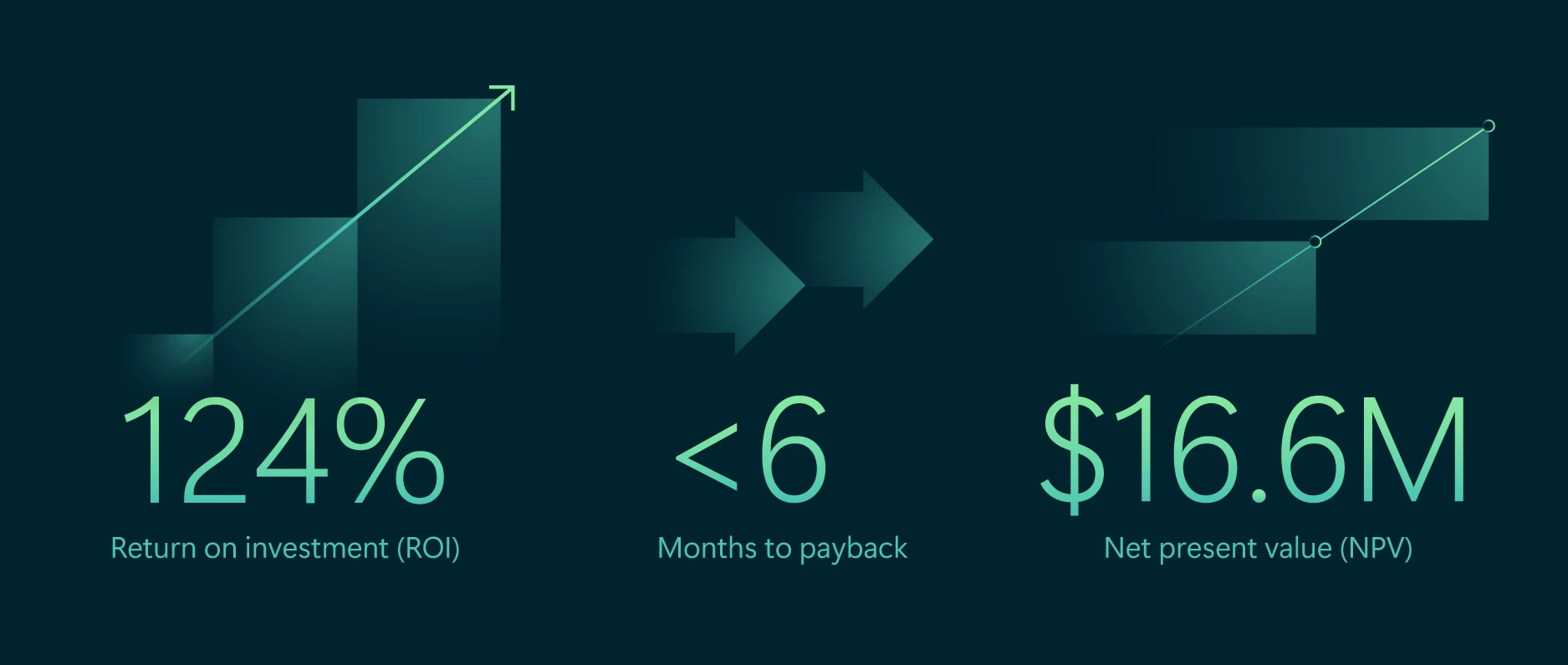
Based on interviews, Forrester’s financial analysis found that a composite organization experiences $30.0 million in benefits over three years versus $13.4 million in costs, resulting in a net present value (NPV) of $16.6 million and an ROI of 124%.
Read the full Forrester TEI study for a complete methodology, assumptions, and detailed financial analysis.
Microsoft Security allows us to deploy modern solutions and be on the leading edge of technologies at enterprise scale.”
—Senior information security officer, NGO
Value beyond what’s measured
The numbers tell part of the story. What we hear from defenders and what the Forrester study reinforces is that the real value of consolidation shows up in the work itself: faster decisions, less friction, more time spent on the cyberthreats that matter. That’s especially true as AI changes both what cyberattackers can do and what defenders can build.
- Security for AI – New solutions like Microsoft Agent 365 with foundations of Microsoft Security, extend identity, governance, and control to AI agents, so customers can adopt them with confidence.
- AI for Security – Microsoft Security Copilot, together with Microsoft Defender, Entra and Purview provides AI-assisted insights to help defenders investigate, prioritize, and respond to security incidents.
- Security foundations for Zero Trust – Identity and access controls work consistently across the environment, without stitching together multiple vendors.
- Simplified hiring and skill development – Building on tools security teams already know makes it easier to recruit, onboard, and grow talent.
- Improved employee experience – Single sign-on and streamlined device onboarding reduce friction, so people can focus on their work.
I like Microsoft because it’s the only vendor that provides a single view or a single location for all the security needs: cloud posture, endpoint protection management, data loss prevention. You don’t have that many vendors today that have the Swiss Army Knife-style platform.”
—Regional chief information security officer (CISO), engineering
An evolving playbook for the agentic era
An integrated approach to security is especially important as threat complexity grows—some organizations use an average of 45 security tools,2 which can increase operational overhead and limit visibility. At the same time, AI-powered threats are accelerating. As human-led AI agents begin to respond to threats, a connected security model becomes even more critical—extending consistent protections not only to traditional surfaces, but also to emerging layers such as prompts, models, plug-ins, and the agents themselves.
Security as the core primitive of the AI stack
As security systems evolve to meet the demands of the agentic era, we see security differently. In the agentic era, security should be the core primitive of the AI stack—woven into and around every layer, ambient, and autonomous, like the AI it protects.
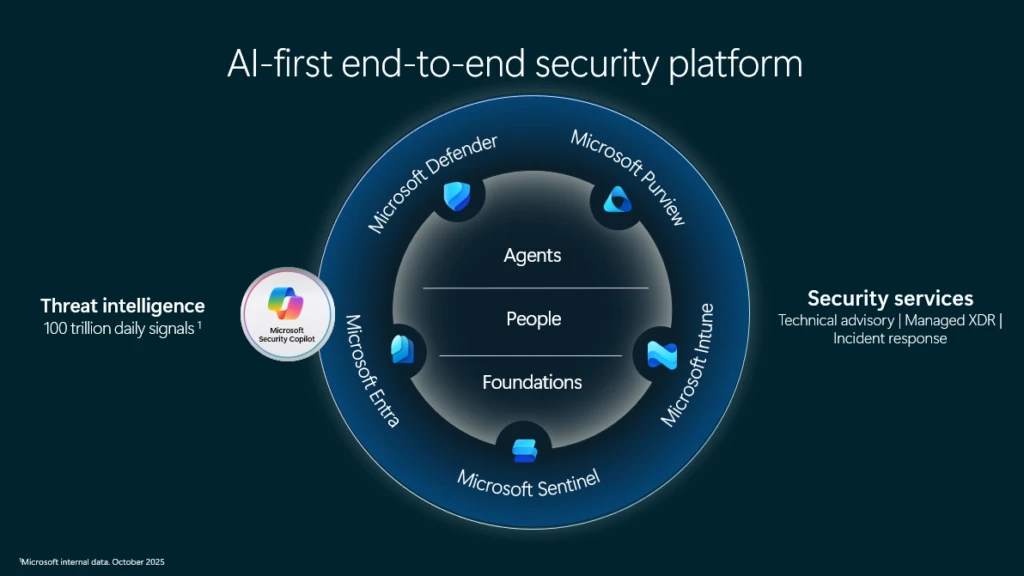
This principle is why we built our platform end-to-end—from identity and endpoint management to data security, compliance, and threat protection—creating an agentic defense platform that unifies the security operations center (SOC) and uses AI to help defenders operate at machine speed with Microsoft Security Copilot. Microsoft Agent 365 extends on this foundation as the control plane for agents, giving security, IT, and business teams the visibility and controls they need to govern agents at scale. Built to work together natively, these aren’t separate products that happen to integrate. They’re a single platform designed for end-to-end security in the age of AI.
Microsoft has done an excellent job developing security agents such as identity and intelligence… Microsoft is innovating as fast as tech startups in the space.”
—Global CISO, professional services
Built to secure what comes next
The era of agentic AI doesn’t just raise the stakes for security. It changes what security should be. Alongside our customers and our partners, we’re building the future of security. Read the full Forrester Total Economic Impact™ of Microsoft Security study. Explore end-to-end Security for AI to learn how to safeguard your AI platforms, apps, and agents with comprehensive solutions.
To learn more about Microsoft Security solutions, visit our website. Bookmark the Security blog to keep up with our expert coverage on security matters. Also, follow us on LinkedIn (Microsoft Security) and X (@MSFTSecurity) for the latest news and updates on cybersecurity.
1Cyber Pulse: An AI Security Report. Microsoft Security Insider.
2Gartner Identifies the Top Cybersecurity Trends for 2025,” March 3, 2025. https://www.gartner.com/en/newsroom/press-releases/2025-03-03-gartner-identifiesthe-top-cybersecuri…
如有侵权请联系:admin#unsafe.sh