
Most organizations build incident response (IR) programs around information technology (IT) environments, centering on data protection. When a cyberattack hits operational technology (OT), those same plans often fail. That’s because OT incident response demands different priorities, skills and decisions-making, all of which are critical when a single incident can lead to costly equipment damage, environmental harm and even risk to human life.
TL;DR: OT incident response (IR) is fundamentally different from IT IR because safety, availability and operational continuity take priority over data protection and containment speed.
Key takeaways:
- Standard IT IR actions in an OT incident may cause more damage than the attack itself.
- Organizations need OT-specific plans, playbooks and trained responders in place (and, ideally, tested) before an incident occurs.
What Makes OT Environments Different From IT?
IT environments protect data and identities. OT environments run the physical world.
Industrial control systems (ICS), Supervisory Control and Data Acquisition (SCADA) systems and programmable logic controllers (PLCs) manage pipelines, power grids, city services, water treatment facilities, manufacturing lines and more. A single compromise in these environments does much more than expose information. Once inside, a threat actor can halt production, trigger safety failures and endanger operators and communities.
How do OT Incident Response Priorities Differ From IT?
The classic CIA triad (Confidentiality, Integrity, Availability) for IT incident response flips completely in OT environments.
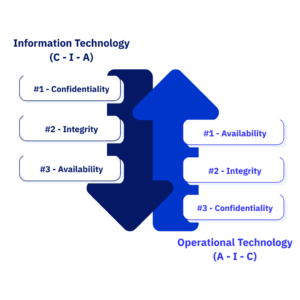 OT security professionals rank system availability as their top priority, compared to IT, which typically prioritizes confidentiality. That is because, in an OT incident, safety MUST come first.
Responders in OT environments start with assessments on the impact to people, processes and devices before taking any technical action. Systems stay online – even if they’re compromised. Availability comes second. Keeping systems operational or restoring them safely is the primary recovery objective. Integrity and confidentiality follow. Data protection matters, but never at the expense of operational safety or continuity.
This is not a subtle difference. It fundamentally changes how responders plan for incidents, assess impact, make containment decisions and communicate with stakeholders before, during and after an active incident.
Why do Standard IT Response Tactics Backfire in OT Environments?
OT environments react differently during common IT playbook responses such as asset isolation, manual takeover or patching. In IT networks, these actions make sense. One user or maybe a few users, might be stuck waiting for a while, but there is no risk of harm while their devices remain under quarantine and investigation. In OT environment, everything changes:
Isolation Can Cause Immediate Harm: Disconnecting a system that controls a physical process can trigger uncontrolled shutdowns. Those shutdowns can damage equipment, release hazardous materials or remove safety controls entirely. Responders must understand the physical consequences of every isolation action before executing.
Manual Control of OT Systems Requires Operational Knowledge: Similar to IT environments, manual control of a compromised system is often the most effective path toward resolution. But where manual operation of an IT system is for hands-on threat analysis while the system remains quarantined, operator control of an OT system is for operational continuity. The device remains operational while manual control limits the blast radius of compromised automated control systems. This type of manual takeover for OT requires trained operators, documented procedures and coordination across security, engineering and operations teams. IT-trained responders often do not have that operational context.
Patching Is Often Not an Option: IT teams patch systems quickly to remove vulnerabilities. OT teams frequently cannot. Many OT systems run software that vendors no longer support. Others require coordinated downtime windows that need to be approved months in advance. Applying an unauthorized patch can void warranties, break integrations or violate regulatory requirements. Responders need pre-approved decision matrices, not improvised solutions.
Five Steps to Build OT Incident Response Readiness Before You Need It
When an incident hits your OT environment, your team needs to know how to respond. IT plans, playbooks and tabletop exercises build valuable skills, but OT environments introduce constraints and consequences that require additional preparation. Without OT-specific training and tested procedures, even experienced responders can face situations where the right next step is unclear.
Here is where to start:
Step 1: Build an OT-Specific Incident Response Plan
IT IR plans are built around data protection and IT team communication chains. OT environments involve a fundamentally different set of stakeholders: plant operators, OT engineers, control system vendors, safety officers, legal counsel, regulators and sometimes city and state officials all make the list in the case of OT. Your OT IR plan needs to define how those stakeholders communicate, escalate or make decisions under pressure.
More critically, OT IR plans should include pre-approved decision matrices. During an active incident, responders cannot pause to debate who should decide if isolating a system is safe. Those decisions must be made in advance, documented and approved by all relevant parties before an attacker forces the issue.
Step 2: Build Threat-based Playbooks for Your Most Likely OT Scenarios
An IR plan defines the framework. Playbooks define the tactics. Every containment step, every recovery action and every handoff procedure should be evaluated against the physical consequences of execution in your specific environment. Isolating a network segment that controls a safety system is not the same as isolating a file server.
Start with your three to five highest-probability threat scenarios. Common starting points include ransomware spreading from IT to OT networks, Human Machine Interface (HMI) compromise, historian exfiltration, supply chain infection and unauthorized remote access through third-party vendor connections. Build decision trees that account for what happens if containment is not possible, if a vendor must be involved or if switching to manual control is the safest path.
Playbooks built in advance become the foundation of practice, which leads to muscle memory.
Step 3: Run Tabletop Exercises That Reflect the Stakeholder Map
Effective OT IR exercises expose coordination failures before a real incident capitalizes on those gaps. It requires three types of tests with the right people in the room to surface different gaps:
- Technical exercises should include site operators, OT engineers and control system vendors who understand the physical environment. They test whether responders know what to do when systems are under attack.
- Can they override affected devices and assume manual control?
- Do they recognize the signs of tampering or infiltration?
- Do they know who to call and when?
- Executive exercises should include the C-Suite, plant managers, legal, communications and operations leadership who own crisis decisions. They test whether leaders can make fast, informed decisions under pressure.
- Do executives understand the operational and regulatory consequences of each option?
- Are communication and escalation paths clear before a crisis forces the question?
- Joint IT/OT exercises simulate scenarios that cross both environments and test the coordination between response teams. They reveal whether IT and OT teams can operate together without creating new risks.
- Do handoffs between teams work as planned?
- Does each team understand where their role ends and the other begins?
Run all three. Then update your plans based on what breaks.
Step 4: Establish Access to OT IR Specialists Before an Incident Occurs
During an active OT incident, every minute of downtime carries potential safety and financial costs. Production loss in critical industries is often measured in millions of dollars per hour and in extreme cases, can put entire communities at risk. Having something in place already isn’t optional, it’s essential.
OT incident response requires practitioners with a specific combination of skills: cybersecurity expertise, industrial control systems knowledge and operational context. IT-trained responders are critical for the systems under their control, but they alone rarely have that combination of specialized knowledge.
Having a continuous OT IR relationship eliminates delays and ensures you have instant access to qualified responders around the clock. It also ensures those specialists are already familiar with your environment, your plans and your stakeholder structure before they are needed.
Step 5: Build and Test OT-specific Backup and Recovery Capabilities
Many OT systems run legacy or proprietary software with no commercial backup solution. Configuration files, logic programs and historical data may exist in formats that standard IT backup tools cannot capture. Air-gap requirements, vendor dependencies and network segmentation add further complexity. Unfortunately, these issues often compound silently and organizations discover their OT backups are incomplete, outdated or untested only when they need them most.
Building OT backup and recovery capabilities requires assessing current coverage gaps, developing strategies that account for proprietary systems and vendor constraints and validating those strategies through regular recovery exercises. Rapid OT response only gets you so far… data recovery is the true (and often overlooked) foundation of long-term OT resilience.
The Cost of Waiting Is Higher Than the Cost of Preparing
OT incident response readiness is an ongoing program that requires careful planning, the right people and regular testing to stay effective. Organizations that invest in OT-specific IR capabilities before an incident can recover faster, limit operational damage and protect the people and communities that depend on their systems.
If you are wondering whether your organization’s OT environment could withstand a cyberattack, register for our Brick House webinar – OT Incident Response: Risk, Impact and Real-World Readiness. Our OT security and incident response experts will walk through the real-world challenges of responding to OT incidents, the most common gaps organizations discover too late and practical steps to strengthen your readiness now.


The Birth and Death of “LoopyTicket” – Our Story on CVE-2025-33073

When to Call for Backup: How to Know It’s Time for IR Support