Security teams today manage increasingly complex environments in which threats such as ranso 2026-6-8 15:24:48 Author: www.bleepingcomputer.com(查看原文) 阅读量:2 收藏
Security teams today manage increasingly complex environments in which threats such as ransomware, advanced persistent threats, and supply chain attacks evolve rapidly. Organizations operate hybrid infrastructures spanning on-premises systems, multi-cloud platforms, containers, and Kubernetes clusters, all while navigating strict compliance requirements from frameworks including PCI DSS, HIPAA, GDPR, NIST 800-53, and CIS Benchmarks.
Security operations centers (SOCs) commonly receive thousands of alerts per day, with high false-positive rates. Analysts can spend most of their time analyzing these false positives rather than investigating real threats.
This contributes to burnout, delays in mean time to detect (MTTD) and mean time to respond (MTTR), and exploitable security gaps.
This reality leaves organizations under-protected despite significant investments. Deployment delays mean limited visibility during critical onboarding periods. Ongoing infrastructure management diverts skilled analysts toward patching, tuning, and cluster maintenance rather than proactive threat hunting.
In dynamic environments, performance degradation and costly re-architecture become the norm, while inflexible licensing models force teams to either overpay for unused features or operate without essential capabilities.
This post explores some of these challenges and demonstrates how Wazuh Cloud solves them. Wazuh Cloud is a fully managed, cloud-native version of the open source Wazuh platform. It simplifies operations through automation, intelligent AI-driven analysis, and seamless scalability.
By removing infrastructure overhead and enhancing detection precision, Wazuh Cloud empowers security teams to focus on what matters most: protecting critical assets in real time.
Challenges in modern security operations
Security teams commonly encounter several operational realities when deploying and running SIEM/XDR platforms:
- Extended deployment timelines: Provisioning infrastructure, rolling out agents across heterogeneous endpoints, configuring data ingestion, tuning detection rules, and integrating with existing tools can take weeks or even months. This extended onboarding period leaves critical visibility gaps during a vulnerable transition phase.
- Sustained maintenance demands: Self-managed environments require ongoing efforts in OS patching, indexer performance tuning, rule updates, cluster scaling, and data retention management. These tasks consume valuable analyst time that could otherwise be devoted to threat hunting and incident response.
- High alert volumes with limited context: In active environments, SIEMs can process millions of events and generate thousands of alerts daily. Without robust correlation and contextual enrichment, teams face substantial triage workloads, impacting MTTD and MTTR.
- Scaling constraints in modern infrastructures: As endpoint counts increase or organizations embrace cloud-native technologies, performance bottlenecks emerge, often necessitating costly hardware investments or architectural overhauls.
- Inflexible consumption models: Rigid licensing structures and tiered feature sets can lead to either overprovisioning costs or the omission of key capabilities tailored to specific needs. Organizations seek solutions that precisely align with their agent volume, data retention, and feature requirements, without rigid constraints.
- Support limitations: Many solutions rely on reactive, ticket-based assistance, lacking proactive platform health monitoring and specialized guidance during critical issues.
These factors often result in higher operational costs and increased pressure on security teams.
How Wazuh Cloud fixes these challenges
Wazuh Cloud provides a managed SIEM/XDR solution designed to minimize infrastructure demands while maximizing security effectiveness:
- Rapid time-to-value: After quick sign-up, Wazuh supports lightweight Wazuh agent deployments across Windows, Linux, macOS, containers, and cloud workloads to achieve full visibility. Pre-configured rules and intuitive dashboards activate immediately. Key security modules such as File Integrity Monitoring (FIM) for detecting unauthorized file changes, vulnerability detection for identifying known weaknesses across systems, and Security Configuration Assessment (SCA) for evaluating compliance against industry benchmarks are all enabled automatically. This out-of-the-box setup delivers comprehensive protection without the usual lengthy configuration process.
- Zero-maintenance platform: Wazuh manages all backend operations, security patches, rule enhancements, threat intelligence updates, and version upgrades, delivering minimal operational impact for your team.
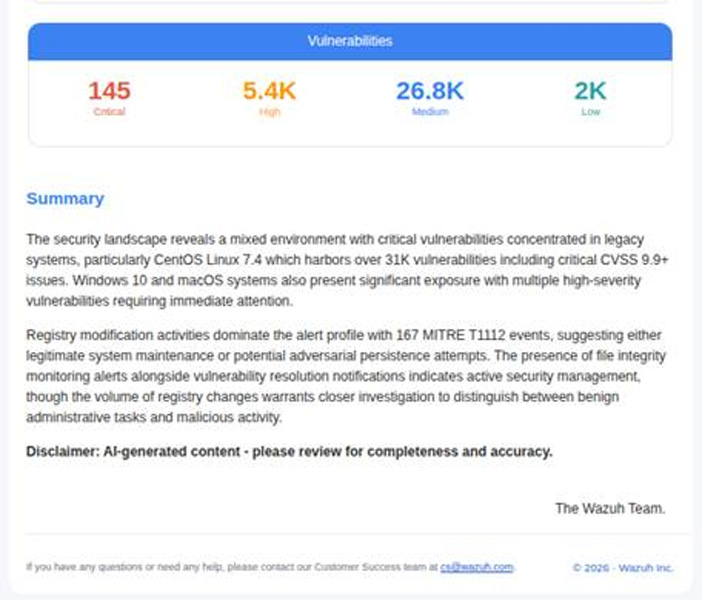
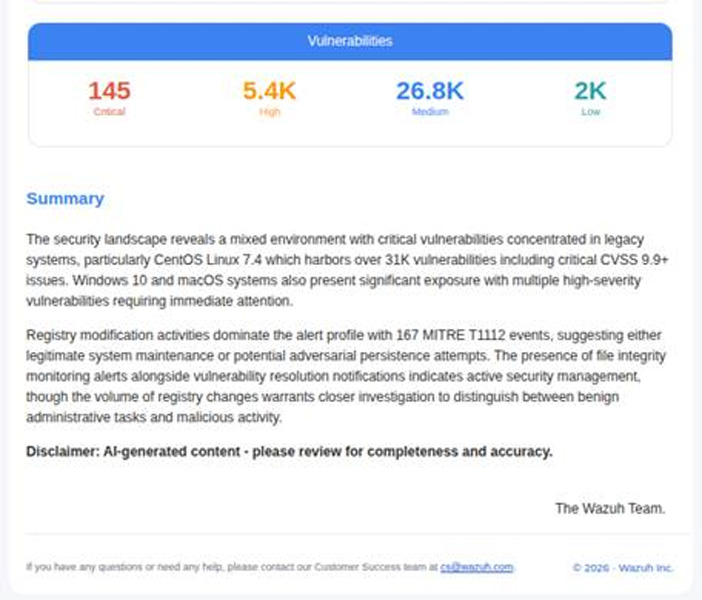
- Wazuh AI Security Analyst: This Wazuh service delivers automated AI-powered security analysis for Wazuh Cloud environments. It analyzes security alerts, vulnerability data, and endpoint activity to generate actionable insights that help organizations better understand their security posture and prioritize remediation efforts. Weekly AI-generated assessments and recommendations highlight trends, high-risk activity, and investigation priorities, reducing manual analysis, alert fatigue, and triage time while improving overall operational efficiency.
- Automatic scalability: Wazuh Cloud resources dynamically adjust to agent volume and data ingestion rates, reliably supporting environments from hundreds to thousands of agents without performance degradation.
- Flexible tiering: Select the tier that fits your current agent count, data retention, and module needs. Upgrades for extended retention or advanced analytics are straightforward, though some setting changes are applied via support workflow and may take effect on the next billing cycle.
- Proactive support and monitoring: Continuous health checks on clusters, agents, and ingestion pipelines, combined with direct access to Wazuh experts.
How Wazuh Cloud works
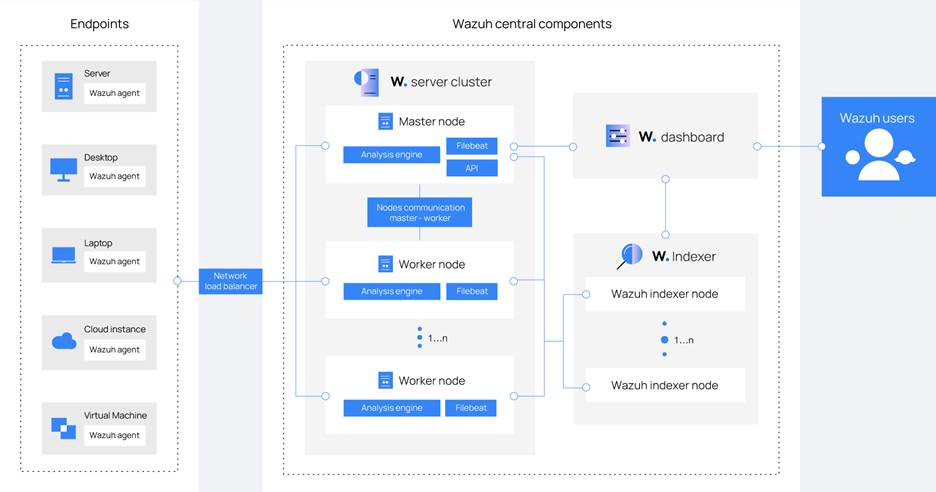
Wazuh Cloud is built on a robust distributed architecture optimized for managed delivery.
Agent-Server model
Lightweight Wazuh agents installed on endpoints collect logs, monitor file integrity, assess configurations, and detect rootkits locally. Normalized events are securely forwarded to the managed Wazuh Cloud server over an encrypted channel, reducing bandwidth usage while maintaining strong visibility across distributed and high-latency environments.
Indexing and data pipeline
A managed Wazuh indexer cluster handles indexing with pre-optimized shards, retention policies, and query performance. Automatic horizontal scaling prevents the degradation typical in self-managed environments.
Detection engine
Raw logs are parsed by decoders, then evaluated against thousands of rules organized by severity, category, and MITRE ATT&CK techniques. Advanced rule chaining across multiple data sources enables precise correlation and significantly lower false-positive rates.
Wazuh AI analyst layer
Wazuh AI Analyst sits above the core detection capabilities. It processes security alerts, vulnerability findings, and endpoint activity data to automatically generate weekly reports with insights, trend analysis, high-risk highlights, and prioritized remediation recommendations.
This reduces the manual effort required for investigations and helps teams focus on strategic threat detection and response.
Conclusion
The limitations of traditional SIEMs are not merely inconveniences; they translate directly into slower detection, higher operational costs, and security gaps that adversaries exploit.
Prolonged deployments mean delayed visibility. Maintenance burden means distracted teams. Alert fatigue means real threats are buried in noise.
Wazuh Cloud addresses these problems by reducing the complexity of managing your security operations. A managed, cloud-native architecture handles the infrastructure, maintenance, and scalability challenges that consume security teams in self-managed environments.
The built-in AI analyst reduces the cognitive load of triage, and a flexible tiering model ensures organizations pay for what they actually need.
For security teams operating in dynamic, hybrid, or multi-cloud environments, the question is no longer whether a managed SIEM is viable; it is whether the cost of maintaining a traditional one is still justifiable. Wazuh Cloud makes that case straightforward.
Visit Wazuh Cloud to start a free trial and experience immediate visibility and protection in your environment today.
Sponsored and written by Wazuh.
如有侵权请联系:admin#unsafe.sh